SEO & Content
Semantic SEO content writing that ranks and gets cited
Our content writing service produces web pages, articles and product copy written to semantic SEO rules. Every page starts from a brief built on real search data, answers the question in its first sentence, states facts with numbers and sources, and links into your topical map, so it ranks in Google and gets cited by AI answer engines.
Semantic content writing vs traditional SEO writing
Both aim to rank. Only one is engineered to be understood, extracted and trusted.
- Starting point
- Traditional SEO writing: A keyword and a word count
- Semantic content writing: A brief built from the query network
- Opening
- Traditional SEO writing: An introduction that warms up
- Semantic content writing: The answer in the first sentence
- Facts
- Traditional SEO writing: “Many”, “several”, “can help”
- Semantic content writing: Exact numbers, named sources, certain claims
- Headings
- Traditional SEO writing: Chosen by the writer
- Semantic content writing: Derived from real queries, in one logical order
- Entities
- Traditional SEO writing: Keyword density
- Semantic content writing: Entities, attributes and values stated explicitly
- Internal links
- Traditional SEO writing: Added at the end, “click here”
- Semantic content writing: Planned in the brief with title-matching anchors
- Length
- Traditional SEO writing: Padded to a target
- Semantic content writing: As short as possible, as long as necessary
- Result
- Traditional SEO writing: Ranks for a few phrases
- Semantic content writing: Ranks for the cluster and gets cited by AI answers
Content we write
Every format follows the same rulebook, adapted to its search intent.
Service pages
Commercial pages that define the service, answer process and pricing questions, and convert.
Landing pages
Campaign pages for organic and paid traffic with one intent and one action.
Blog articles
Supporting articles that answer the questions around your services and link back to them.
Pillar guides
Long-form references that cover a subject completely and anchor a topic cluster.
Product and category copy
Descriptions with every attribute and value buyers compare, for Shopify and WooCommerce stores.
Location pages
Local pages with real service areas, response times and regional details, not swapped city names.
FAQ content
Direct one-sentence answers built for People Also Ask and AI Overviews.
About and author pages
Entity pages that state who you are, your credentials and your experience.
Content refreshes
Rewrites of underperforming pages: corrected intent, current facts, tighter structure.
Every page starts with a semantic content brief
A brief is a production document, not a keyword list. It tells the writer what to write, in which format, in what order and with which links.
Our briefs contain 7 components: page identity, query network, attribute filtration, the contextual vector (heading outline), the format of each section, contextual bridges (internal links) and uniqueness additions.
Attributes are scored by prominence, relevance and popularity, so popular but off-topic ideas never reach the page. Every brief includes at least one angle that none of the top five competitors cover.
- Page identity
- Core page · transactional intent · priority high
- Query network
- 6 clusters: repair, leaks, cost, emergency, materials, warranty
- H1
- Commercial roof repair for flat and low-slope roofs
- Opening answer
- 40-word definition with response time and roof types covered
- Contextual vector
- Definition → problems fixed → process → cost factors → booking → FAQs
- Formats
- Cost factors as a table, process as a numbered list
- Contextual bridges
- Up to roofing services, across to leak detection, down to TPO roof repair
- Uniqueness
- Repair-or-replace decision table by roof age
- Schema
- Service, FAQPage, BreadcrumbList
Our semantic writing rulebook
Every writer, editor and AI-assisted research step at Qovex Studio follows the same rules. Here they are, with examples.
38 rules in 6 categories
Answer first
Information responsiveness: the answer comes before everything else.
Rule 01: Answer in the first sentence
The sentence under a heading answers the heading. Context and detail come after it.
- Before
- Choosing a CRM is an important decision for any growing business, and there are several factors to consider.
- After
- The right CRM for a 10-person sales team matches its sales cycle, its budget per seat and the tools it already uses.
Rule 02: Mirror the heading’s words
Repeat the heading’s nouns and verbs in the answer, in the same order and the same form.
- Before
- Heading “How to reduce page load time”: Page load time is a key website metric.
- After
- Heading “How to reduce page load time”: To reduce page load time, compress images, defer unused JavaScript and serve files from a CDN.
Rule 03: Define with the parent category
A definition names the class an entity belongs to, then what makes it different.
- Before
- Kratom is something many people use for energy.
- After
- Kratom is a tropical tree in the coffee family (Rubiaceae) whose leaves contain the alkaloid mitragynine.
Rule 04: Start yes/no answers with yes or no
Boolean questions get a direct answer first, then the reason.
- Before
- Many experts have debated whether guest posts are still worth it.
- After
- Yes, guest posts still help SEO when they are published on relevant sites with real readers.
Rule 05: Keep snippet answers near 40 words
Featured snippet and People Also Ask answers stay around 40 words. The long answer follows below them.
Rule 06: Bold the answer, not the keyword
Bold text signals the answer part of a sentence, never the search term.
- Before
- Topical authority is the trust a website earns for a subject.
- After
- Topical authority is the trust a website earns by covering a subject completely.
Certainty and facts
Facts are stated as facts: present tense, real numbers, named sources.
Rule 07: State facts in the present tense
Modals such as can, may, might and should signal opinion. Facts use the present tense.
- Before
- A slow website can lose customers.
- After
- A 0.1-second faster mobile site increased retail conversions by 8.4% in Deloitte’s 2020 “Milliseconds Make Millions” study.
Rule 08: Declaration first, condition second
Give the instruction or result, then the condition that limits it.
- Before
- If your bounce rate is high, you should rewrite the introduction.
- After
- Rewrite the introduction, if the bounce rate on informational pages is above 70%.
Rule 09: Use exact numbers
Replace “many”, “several” and “various” with the real count.
- Before
- There are many ways to speed up a website.
- After
- There are 5 main ways to speed up a website: image compression, caching, a CDN, code splitting and faster hosting.
Rule 10: Qualify the instances
Say how many and which kind: common, rare, severe, optional.
- Before
- The symptoms of a failing water heater include several issues.
- After
- A failing water heater shows 4 common symptoms and 2 rare ones.
Rule 11: Name examples after plural nouns
Every plural noun is followed by real examples of it.
- Before
- Shopify supports several payment gateways.
- After
- Shopify supports more than 100 third-party payment gateways, including Stripe, PayPal and Authorize.net.
Rule 12: Cite the source before the claim
Name the organization, study or expert, then state the finding.
- Before
- Studies show people skim web pages.
- After
- Nielsen Norman Group’s eye-tracking research found that users scan web pages in an F-shaped pattern.
Rule 13: Keep declarations consistent
One fact has one value everywhere: every page, profile, listing and ad.
- Before
- Founded in 2015 on the About page, 2016 on LinkedIn.
- After
- Founded in 2015, on every page and every profile.
Sentence craft
Short, dense sentences that a parser and a person read the same way.
Rule 14: Write short subject–verb–object sentences
Long sentences build long dependency trees and dilute the meaning between words.
- Before
- The reason the page ranks higher is mainly due to the improvement of its internal links.
- After
- Better internal links raised the page’s rankings.
Rule 15: Cut contextless words
Delete every word that does not change the meaning: basically, really, it is important to note that.
- Before
- It is important to note that basically every page really needs a clear title.
- After
- Every page needs a clear title.
Rule 16: Choose verbs by context
Verbs signal the domain: develop skills, increase intake, apply a method, achieve a certification.
- Before
- Try to think about using Agile on your project.
- After
- Apply Agile to projects that need rapid iteration.
Rule 17: Order words by the question asked
The attribute the query asks about comes first in the answer.
- Before
- Shopify, a platform launched in 2006, has plans that start at $39 per month.
- After
- A Shopify store costs $39 to $399 per month on the standard plans, plus apps and themes.
Rule 18: Name the entity instead of “it”
Repeat the entity name wherever a pronoun could be ambiguous.
- Before
- It connects to it in minutes.
- After
- Klaviyo connects to Shopify in minutes.
Rule 19: Leave out opinions and analogies
Explain the thing directly. Comparisons to gardens and journeys add words, not facts.
- Before
- Think of SEO like planting a garden: you have to be patient.
- After
- SEO results typically appear 3 to 6 months after publishing, depending on competition.
Entities and meaning
Entities, attributes and values stated so search engines extract facts, not guesses.
Rule 20: Complete entity, attribute and value
Never name an attribute without giving its value.
- Before
- The iPhone 15 has a great battery.
- After
- The iPhone 15 battery lasts up to 20 hours of video playback, according to Apple.
Rule 21: State how entities relate
Connect two entities with a verb that explains their relationship.
- Before
- Core Web Vitals, rankings, user experience.
- After
- Core Web Vitals measure page experience, which Google uses as one ranking signal.
Rule 22: Cover root, rare and unique attributes
Start with the attributes every competitor covers, add the rare ones, then the facts only you can state.
Rule 23: Move from broad to specific
Introduce the category, then its types, then its parts: furniture, sofas, frame and cushions.
Rule 24: Keep the title’s terms in every section
The title’s key terms, their variants and synonyms appear throughout, so every paragraph stays on topic.
Rule 25: Add information gain
Each page adds at least one fact, comparison or data point that the top five results do not have.
Structure and flow
One topic per page, one direction from the first heading to the last.
Rule 26: One macro context per page
Each page has one main topic and one dominant intent. Side topics get their own pages.
Rule 27: Keep a straight context vector
Headings progress logically from the H1 to the last section: definition, types, process, cost, questions.
Rule 28: Write headings as short questions
Question headings match how people search and how Google reads headings.
- Before
- Pricing information and other considerations
- After
- How much does a commercial roof repair cost?
Rule 29: Introduce every list
A lead-in sentence says what the list contains and how many items it has.
- Before
- Here are some tips:
- After
- The following 4 factors decide the cost of a roof repair:
Rule 30: Start list items the same way
Every item begins with the same word type, usually a verb.
- Before
- Image compression · Caching the pages · You should use a CDN
- After
- Compress images · Cache pages · Serve files from a CDN
Rule 31: Explain every table
A sentence before the table says what it compares. A sentence after it states the conclusion.
Rule 32: Separate main and supplementary content
The main content answers the page’s intent. Related questions sit lower, usually as FAQs.
Links and trust
Links that explain relationships, and signals that show who stands behind the page.
Rule 33: Match anchors to the target page title
The anchor text repeats the main words of the page it links to.
- Before
- To learn more, click here.
- After
- Our semantic SEO services build the topical map behind every page.
Rule 34: Plan links up, across and down
Each page links up to its parent, across to sibling topics and down to deeper pages, as planned in the brief.
Rule 35: Link less, say more
A few precise links inside sentences beat a block of “related posts”.
Rule 36: Show who wrote it
Each article carries the author’s name, role and experience, and facts are reviewed by a subject expert.
Rule 37: Keep one brand voice
Tone, terminology and formatting stay the same across every page and every writer.
Rule 38: Never pad to a word count
Content is as short as possible and as long as necessary.
Written to be quoted by featured snippets and AI Overviews
Answer engines extract passages, not pages. We write passages that make sense on their own.
Each section opens with a self-contained answer of about 40 words, and People Also Ask answers fit in one sentence. Lists have a lead-in sentence and tables have a definition, so Google, ChatGPT and Perplexity lift them without losing meaning. FAQ answers carry FAQPage schema, and every fact matches the rest of your site.
- 40-word extractive answers
- One-sentence PAA answers
- Self-contained passages
- Snippet-ready lists and tables
- FAQPage and Article schema
- Consistent facts across the site
Human writers, edited line by line
Pages are written by people who know your subject, then edited against the rulebook before you see them.
AI supports research: clustering queries, summarizing sources and checking coverage. Drafts are written and edited by our team, and editors remove the patterns that make AI text easy to spot: filler openers, vague claims and missing numbers. Regulated topics such as CBD, kratom and finance get an extra fact-check pass.
- Writers matched to your industry
- Line edit against all 38 rules
- Fact-check against named sources
- Plagiarism and originality check
- Your voice and terminology guide
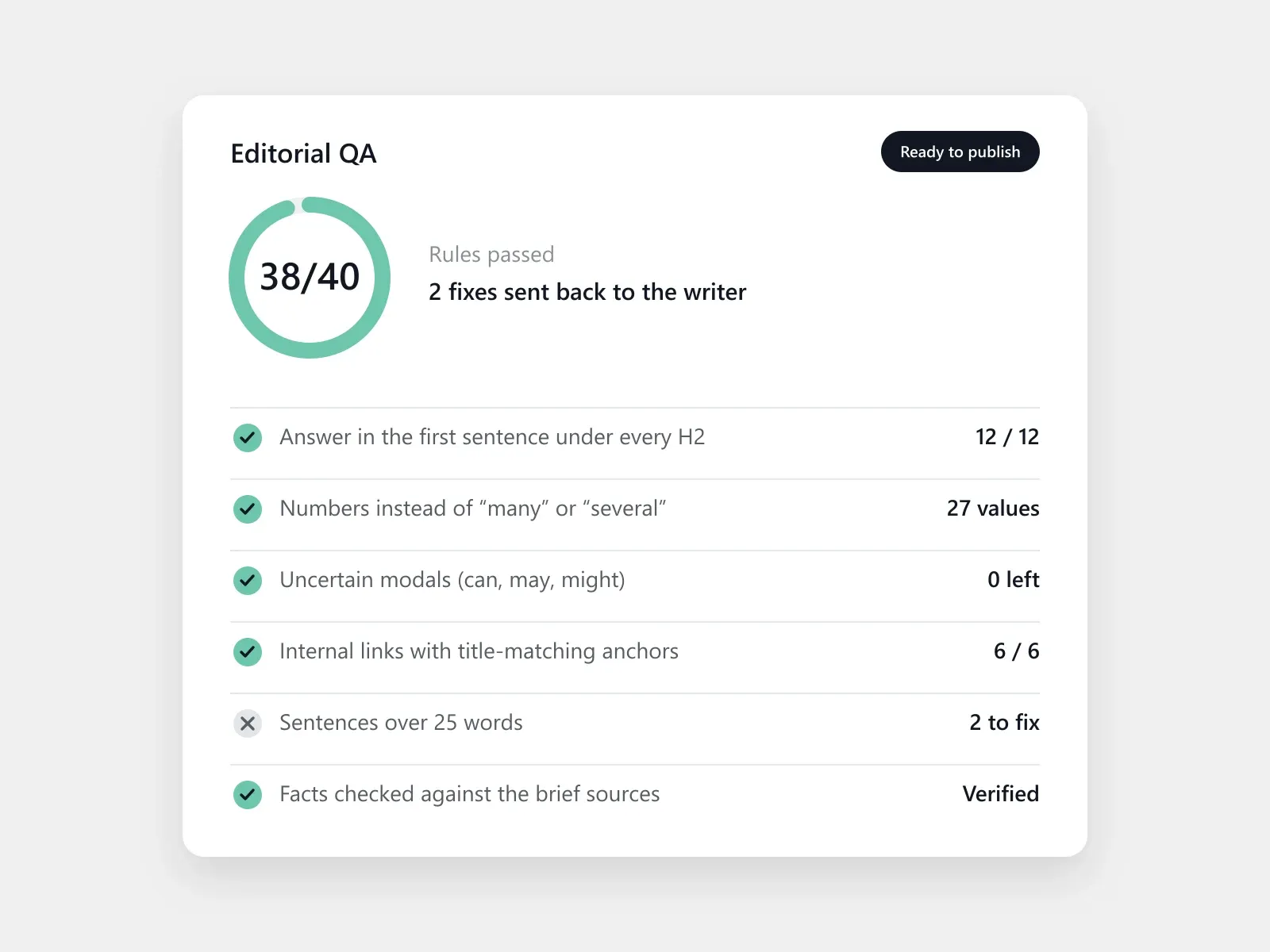
Every page passes editorial QA before delivery
A checklist, not a feeling. A page that fails any item goes back to the writer.
Editors score each draft against the brief and the rulebook, then verify the facts, the links and the technical details. You receive the page with its sources, its meta data and its schema ready to publish.
- Brief followed: headings, formats, links
- Answer first under every heading
- No uncertain modals or filler
- Numbers, examples and sources
- Entity, attribute and value coverage
- Title-matching internal anchors
- Meta title, description and schema
- Spelling, grammar and brand voice
Industries we write for
Specialist and regulated niches, where vague content does not rank and careless claims cost trust.
CBD brands
Compliance-aware copy that informs without unsupported health claims.
Kratom brands
Product, strain and education content that states verifiable facts.
SaaS companies
Feature, comparison and use-case pages for every stage of the buying journey.
Ecommerce stores
Category and product copy with the attributes shoppers compare.
Jewelry brands
Material, cut and care content that answers buyers’ detailed questions.
Moving companies
Service and location pages built around real routes, costs and timelines.
Self storage
Unit size, pricing and location content that turns searches into rentals.
Professional services
Expertise-led pages for firms that sell trust, knowledge and results.
Local businesses
Service-area pages and FAQs for businesses that serve a region.
Tools our writers and editors use
Tools supply data and checks. The writing and the judgment stay human.
12 tools
Research · Entities · Writing · Editing · Originality · Structured data · Technical
Research
- Google Search ConsoleThe queries a page already ranks for, used to expand and refresh it.
- SemrushKeyword clusters, SERP features and competitor content gaps.
- AhrefsTop-ranking pages, their headings and the queries they win.
- AlsoAskedPeople Also Ask question trees for FAQ and H3 planning.
- ChatGPT and ClaudeQuery clustering, source summaries and coverage checks. Never final copy.
Entities
- Google Natural Language APIChecks which entities a draft makes salient.
Writing
- Google DocsDrafting, suggestions and comment-based review with your team.
Editing
- GrammarlyGrammar, spelling and clarity checks.
- Hemingway EditorFlags long sentences, passive voice and filler words.
Originality
- CopyscapePlagiarism checks before every delivery.
Structured data
- Schema Markup ValidatorValidates FAQPage, Article and Service schema.
Technical
- Screaming Frog SEO SpiderFinds thin, duplicate and orphaned pages before a refresh.
How we write your content
Eight steps from your business to a published, measured page, each with a clear deliverable.
- 01
Discovery
Your services, audience, voice and the facts only you know.
Voice and terminology guide
- 02
Query research
Real searches collected and grouped into intent clusters.
Query network
- 03
Topical map fit
Each page gets one job, a core or supporting role and its links.
Page plan
- 04
Semantic brief
Headings, formats, entities, links and uniqueness additions.
Approved content brief
- 05
Writing
A writer who knows your industry drafts the page from the brief.
First draft
- 06
Editing and fact-check
Line edit against the rulebook and verification of every source.
Edited draft with sources
- 07
SEO QA and delivery
Meta data, schema, internal links and final QA, then delivery or upload.
Publish-ready page
- 08
Measure and refresh
Queries, rankings and conversions tracked; pages refreshed when they slip.
Monthly content report
Ways to work with us
Choose the model that fits your team. Every option follows the same rulebook.
Content briefs only
Semantic briefs your in-house writers can follow, with the QA checklist attached.
Per-page writing
Service, landing and product pages written from an approved brief.
Monthly content plan
A steady publishing cadence from your topical map, with monthly reporting.
Blog and pillar clusters
Supporting articles and pillar guides that build authority around your services.
Content refresh program
Audit and rewrite of pages that lost rankings or never ranked.
AI content cleanup
Human rewrites of AI-generated pages that are thin, repetitive or inaccurate.
What we never do
The habits and shortcuts that make content look busy and rank badly.
Writing habits we remove
- Padding to a word count
- Keyword stuffing and synonym spinning
- Opinions, analogies and hype words
- “Can”, “may” and “might” where facts exist
- Introductions that delay the answer
Shortcuts we refuse
- Publishing unedited AI drafts
- Copying competitors’ headings and questions
- Generic “click here” anchors
- Two pages chasing the same intent
- Product promotion inside informational articles
Get content written to semantic rules
Tell us which pages you need. We will reply with a content plan and a sample brief.
Frequently asked questions about Content Writing
What is semantic content writing?
Semantic content writing is a form of SEO content writing that structures pages around entities, attributes and search questions. It answers first, states facts with numbers and sources, and removes filler, so search engines and AI answer engines extract clear facts.
What is the difference between SEO content writing and copywriting?
SEO content writing answers search queries so a page ranks and informs. Copywriting persuades a reader to act. Our service and landing pages combine both: semantic structure for rankings and clear calls to action for conversions.
What does a semantic content brief include?
A semantic content brief includes the page identity, the query network, filtered attributes, the heading outline, the format of each section, internal links with exact anchors, uniqueness additions and the schema type.
Do you use AI to write content?
No. AI supports research, such as query clustering and source summaries. Every page is written and edited by our team and checked against our semantic writing rulebook.
How long should an SEO article be?
An SEO article is as long as the topic requires and no longer. Length follows from the brief: the queries to answer, the attributes to cover and the formats needed. Padding to a word count lowers information density.
How much do content writing services cost?
Content writing cost depends on page type, research depth, subject complexity and volume. Briefs, single pages, monthly plans and refreshes are priced separately; contact us for a quote based on your content plan.
Can you write in our brand voice?
Yes. Discovery produces a voice and terminology guide, and every writer and editor works from it, so pages read consistently across your site.
Do you write for regulated industries like CBD and kratom?
Yes. We write compliance-aware content that states verifiable facts, avoids unsupported health claims and names its sources, which also improves trust and rankings.
Can you improve our existing content?
Yes. Our content refresh program audits pages that lost rankings or never ranked, corrects the intent and structure, updates the facts and adds missing attributes.
Do you upload content to our website?
Yes. We deliver in Google Docs or publish directly to WordPress, Shopify or your CMS with headings, links, meta data and schema in place.
How do you measure content performance?
We track impressions, unique ranking queries, positions and conversions per page in Google Search Console and analytics, then refresh pages that slip.
Who owns the content you write?
You do. All content is original, checked for plagiarism and fully owned by you once delivered.