SEO & Content
Semantic SEO services that build topical authority
Semantic SEO optimizes your website around entities, topics and search intent instead of single keywords. We turn it into one connected system: an entity-based topical map, semantic content briefs, on-page and technical SEO, and relevant authority links, so search engines and AI answer engines understand exactly what you are an expert in.
What is semantic SEO?
Semantic SEO is the practice of making the meaning, context and relationships of your website easy for search engines to understand. Instead of optimizing one page for one keyword, you organize your site around the entities your business is about, the attributes that describe them and the questions people ask about them.
Modern search does not ask which pages contain a phrase. It asks which pages mean the right thing. Google identifies entities, interprets the intent behind a query, and retrieves the passages that answer it best, even when they share no exact words with the search.
A simple example. A keyword page targeting “emergency plumber” repeats that phrase. A semantic page defines the service, covers the problems it solves (burst pipes, blocked drains, failed water heaters), states response times, service areas and pricing factors, answers real questions, links to related services and marks it all up with structured data. Both mention the keyword. Only one fully answers the person searching.
Want the long version? Read our complete guide to semantic SEO.
Semantic SEO vs keyword SEO
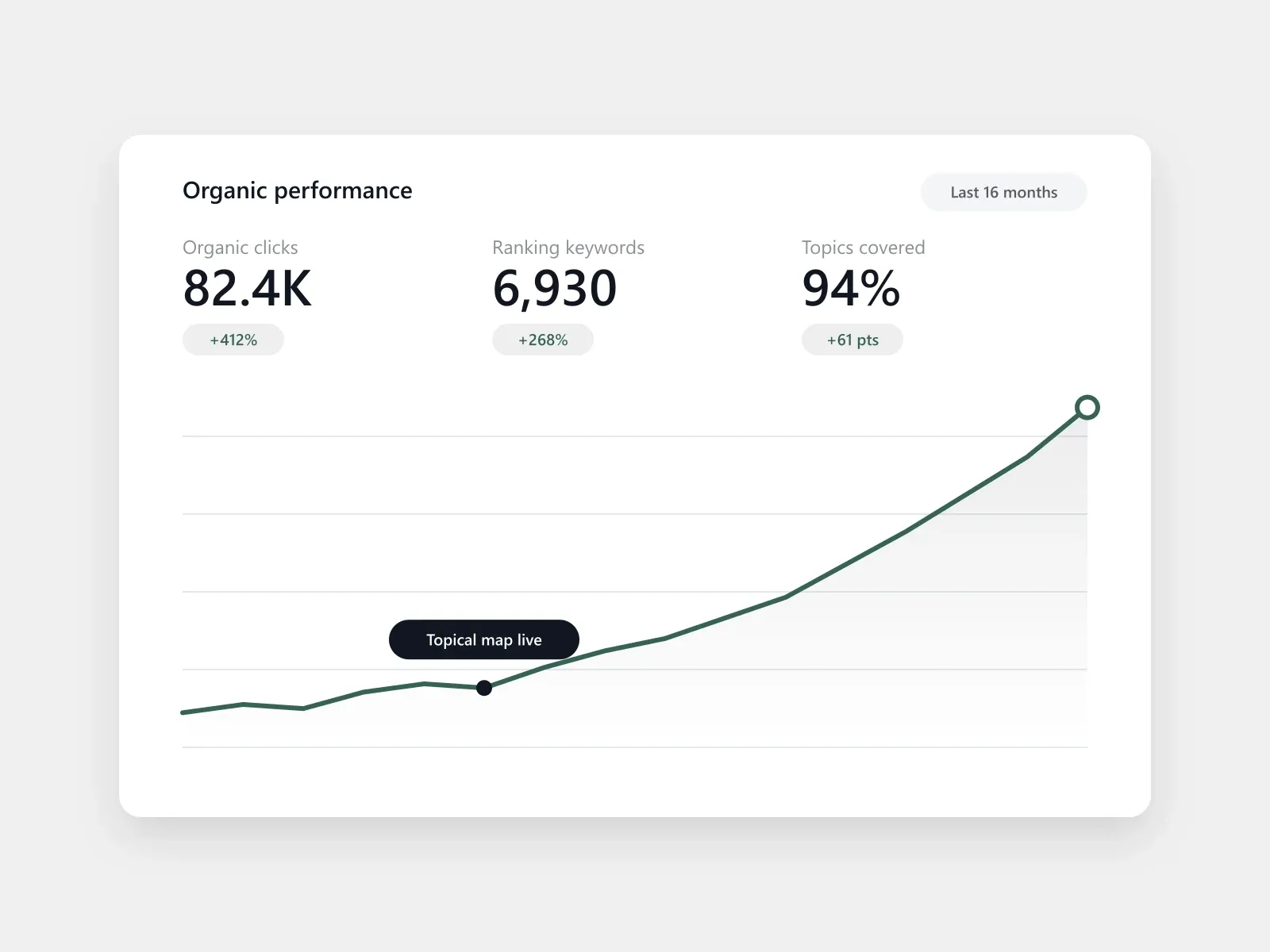
The goal is the same: rankings, traffic and revenue. What changes is the unit of work, from the keyword to the meaning behind it.
- Unit of optimization
- Keyword SEO: One keyword per page
- Semantic SEO: Entities, attributes and search intent
- Research
- Keyword SEO: Search volume and difficulty
- Semantic SEO: Query networks, predicates and result patterns
- Content
- Keyword SEO: Keyword density and word count
- Semantic SEO: Answer-first, fact-dense coverage of the topic
- Site structure
- Keyword SEO: Flat pages and categories
- Semantic SEO: A topical map with core and outer sections
- Internal links
- Keyword SEO: Menus and related posts
- Semantic SEO: Contextual links that explain relationships
- Success signal
- Keyword SEO: Rankings for a list of terms
- Semantic SEO: Visibility across the whole topic, including untargeted queries
- AI search
- Keyword SEO: Rarely considered
- Semantic SEO: Self-contained, citable passages for AI answers
How search engines learned to understand meaning
Semantic SEO exists because search changed. Each milestone moved Google further from matching strings toward understanding real-world things.
2012
Knowledge Graph
Google begins storing facts about entities and how they connect: “things, not strings.”
2013
Hummingbird
The core algorithm is rebuilt to interpret the meaning of whole queries, not single words.
2015
RankBrain
Machine learning relates never-seen queries to known concepts.
2019
BERT
Language models read context, including small words that change what a query means.
2021
MUM
A multitask, multilingual model that understands information across languages and formats.
2024
AI Overviews
Generative answers summarize sources in results, rewarding clear, well-structured content.
The core concepts of semantic SEO
Every project we run starts from the same six foundations, popularized by Koray Tuğberk Gübür’s topical authority framework.
Source context
Why your website exists: what you offer, who you serve, how you earn and why you are qualified. It decides which topics you should cover and how deep to go.
Central entity
The one entity your whole site is organized around. Broad enough to hold every attribute you need, narrow enough to cover completely.
Central search intent
Source context and central entity combined into what users come to do on your site. It produces the verbs (buy, compare, fix, learn) that shape every page.
Entities, attributes and values
Knowledge is stored as things (entities), their properties (attributes) and the answers (values). Pages that name an attribute must also give its value.
Predicates
The relationships that connect entities, such as “grind size determines extraction.” Mentioning two terms says nothing; stating how they relate creates knowledge.
Query networks
The connected set of searches around an entity, branched by intent. Each distinct branch usually deserves its own page, and none should compete.
How search engines read meaning
Six ideas explain why some pages are easy for search engines to trust, and others are not.
Query and document semantics
Search systems decompose the query (entity plus constraints) and the document (what it actually resolves), then rank on how well the two structures match.
Contextual vectors
The direction a page travels from heading to heading. A clean, logical sequence reads as one argument; a random heading list reads as noise.
Macro and micro context
Macro context is what the page is about; micro context is what each section resolves. Every section must belong to the page it lives on.
Semantic distance
How far apart two concepts are in meaning. It decides what shares a page, what gets its own page, and how pages should link.
Cost of retrieval
The work a search engine must do to crawl, render, understand and trust a page. Ambiguity, duplication and slow rendering all raise it.
Information responsiveness
How directly content answers the question it claims to answer. The answer comes first, with values, conditions and exceptions stated plainly.
What our semantic SEO service includes
Each part can run on its own, but they work best as one strategy built around your topical map.
Semantic SEO audit
Coverage, technical health and authority compared with the sites outranking you.
Entity and topical map
Your central entity, attributes, query network and every page you need.
Content briefs
Page-by-page blueprints with entities, predicates, questions and links.
Content writing
Answer-first, fact-dense pages written by our team from the briefs.
On-page SEO
Titles, headings, entities, schema and contextual internal links.
Technical SEO
Crawling, indexing, Core Web Vitals and architecture that mirrors the map.
Off-page SEO
Relevant links, brand mentions, digital PR and entity consistency.
Guest posts
Editorial articles on real, relevant sites with contextual links.
AI search optimization
Citable passages and entity signals for AI Overviews and LLMs.
Topical maps that turn research into a publishing plan
A topical map decides which pages must exist, what each one uniquely owns, how they connect and in what order they ship.
We build it from your source context and real search data, not a keyword export. Every row records the entity, the attributes it resolves, the governing predicate, the search intent and its place in the network.
Core section: pages closest to revenue, such as services, products, categories and locations.
Outer section: pages that answer the definitions, comparisons and questions around them, and link back to the core.
One job per page prevents cannibalization. A planned sequence builds historical data instead of wasting it.
- Source context and central entity definition
- Entity model with attributes and values
- Query network grouped by intent
- Core and outer sections with page jobs
- Internal linking plan and publishing roadmap
Semantic content briefs writers can follow
A topical map tells you what to publish. A brief tells a writer exactly how to write each page so it ranks, reads well and converts.
Our briefs replace keyword lists and word counts with the things that actually matter: the page’s job, its entities and predicates, the attributes that need values, the questions it must answer, its contextual flow and the links it depends on. Writers spend their time on expertise instead of guessing.
- Page job
- Help a growing brand choose a Shopify partner and request a quote
- Search intent
- Commercial: compare providers and pricing factors
- Central entity
- Shopify development service
- H1
- Shopify development services for growing brands
- Opening answer
- 40–60 words defining the service and who it is for
- Attributes + values
- Timeline, cost drivers, platform plan, apps, migration effort
- Contextual flow
- Definition → what’s included → process → pricing → FAQs
- Internal links
- Store migration, theme customization, eCommerce SEO
- Schema
- Service, FAQPage, BreadcrumbList
The rules we write by
Semantic content is not longer content. It is denser, clearer and easier to extract.
Answer first
- Answer each heading in its first sentence
- Define entities near their first mention
- State conditions: “usually X, except when Y”
Complete facts
- Never name an attribute without its value
- State how two entities relate
- Use tables for comparisons, lists for sets
One direction
- Keep one contextual flow per page
- Keep related facts in the same passage
- Cut restatements and filler summaries
Information gain
- Add original data or examples
- Cover rare but relevant attributes
- Show first-hand experience and authorship
On-page SEO on every page
Each page is made clear, complete and useful, for readers first and search engines second.
Relevance and structure
- One dominant intent per page
- An H1 that names the main entity
- Logical H2/H3 hierarchy, often as questions
- Short, descriptive URLs
Content quality
- Entities, attributes and values stated
- Original insight, data or examples
- Clear authorship and expertise signals
- Accurate facts and visible update dates
Search appearance
- Unique titles and meta descriptions
- Structured data for the page type
- Compressed images with alt text
- Open Graph tags for sharing
Connections
- Contextual internal links
- Anchors that describe the destination
- Links from existing pages to new ones
- No orphan pages
Semantic internal linking
An internal link should explain why two pages belong together. Anything else is just navigation.
We place links inside sentences, where the relationship is explained, with anchors that describe the destination. Each link type declares something different to search engines, so we plan them on the topical map before a page is written.
Technical SEO that lowers the cost of retrieval
Semantic signals only count if search engines can crawl, render and index your pages cheaply and without doubt.
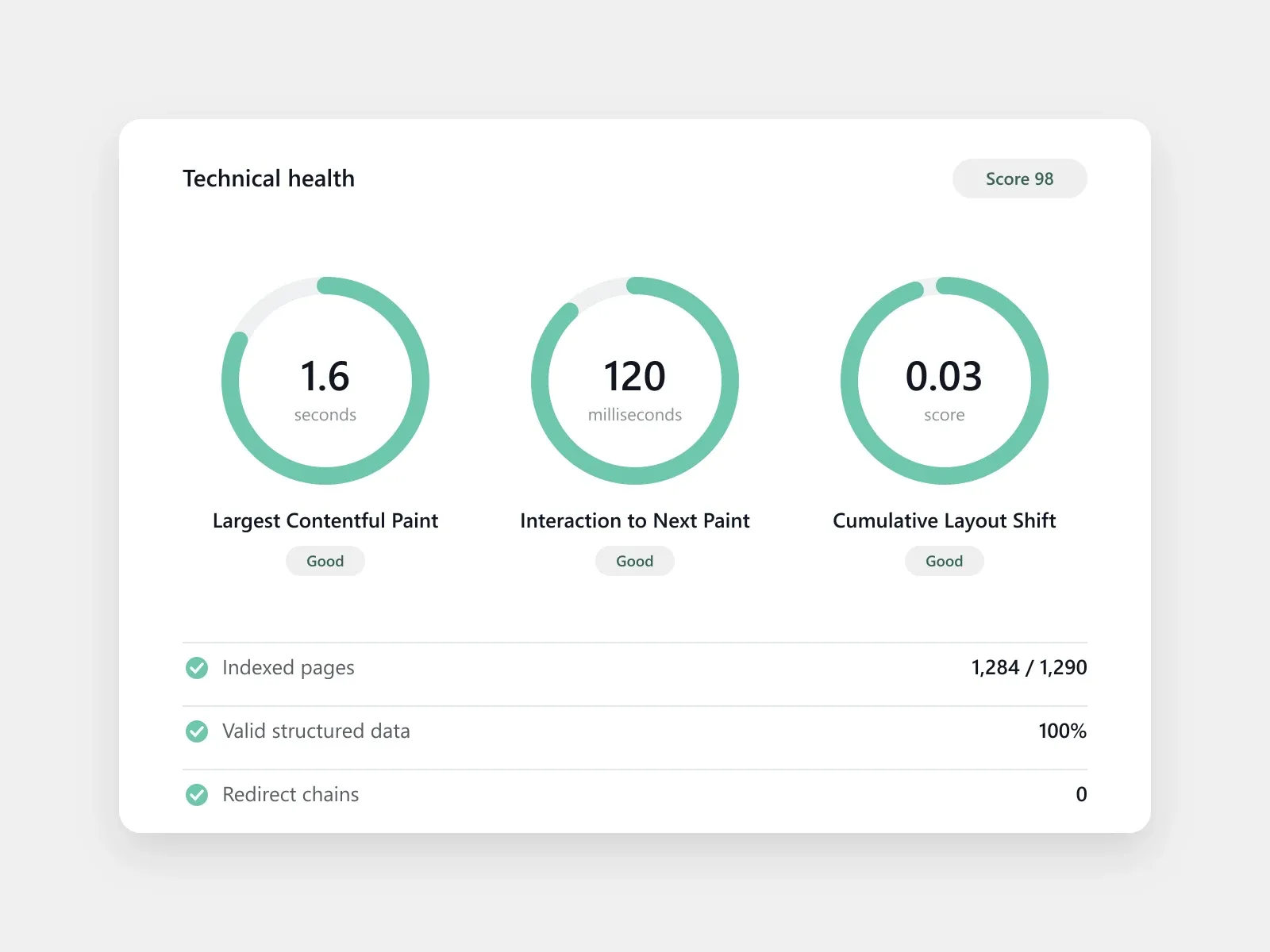
Redirect chains, JavaScript-only content, duplicates, thin pages and conflicting canonicals all force search engines to spend more and trust less. We remove that friction and keep pages worth indexing, so your best content gets crawled first.
- Crawling, indexing and XML sitemaps
- Core Web Vitals: LCP, INP and CLS
- JavaScript rendering and mobile usability
- Canonicals, redirects and duplicates
- Architecture that mirrors the topical map
- Structured data validation
Off-page SEO built on relevance and entity signals
Off-page SEO builds what the rest of the web says about you: links, mentions and consistent facts about who you are.
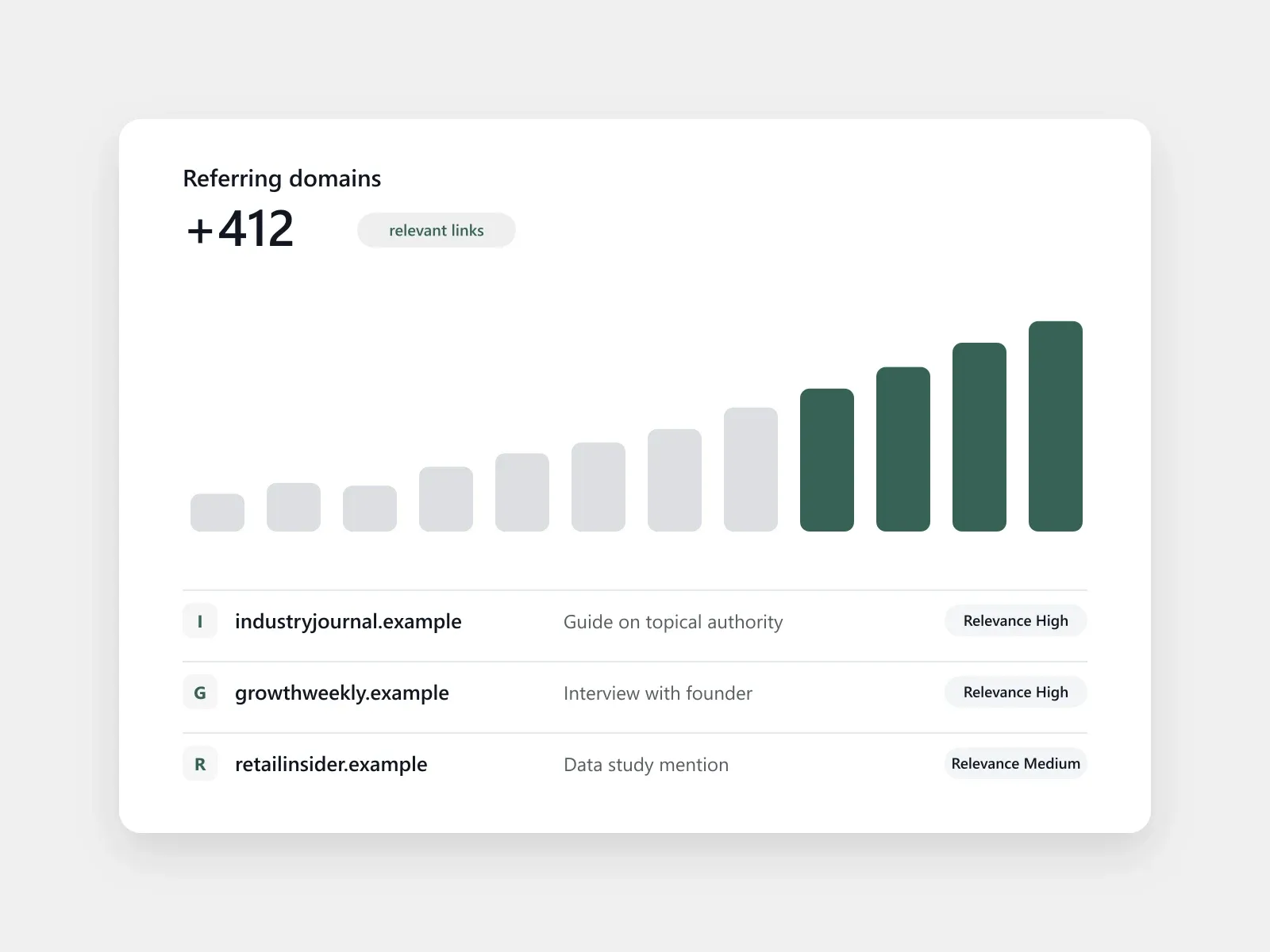
In semantic SEO, relevance beats volume. One link from a site about your topic, inside an article about your topic, outweighs dozens of unrelated links. We also make your business details consistent across directories, profiles and data sources, so search engines can connect every fact to one entity.
- Backlink gap analysis against competitors
- Relevant link acquisition and outreach
- Digital PR and brand mentions
- Entity consistency across profiles and directories
- Review of harmful or spammy links
Guest posts worth publishing
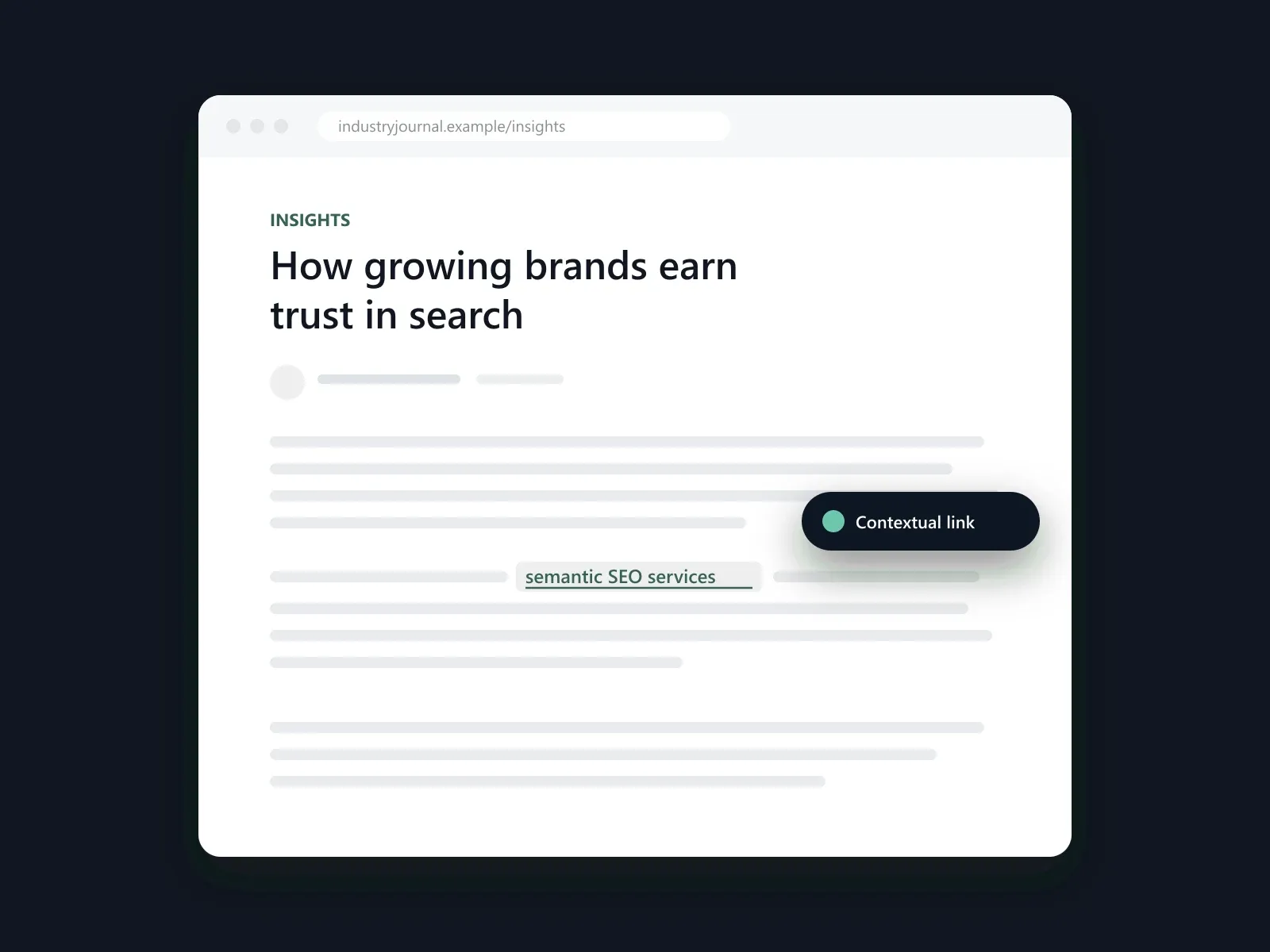
Original articles, written by our team and published on real, relevant websites, with a natural link back to your most important pages.
Every placement passes one test: would the article be worth publishing without the link? The site must cover your industry, have real organic traffic, and follow its own and Google’s link policies, including sponsored attributes where required. No private blog networks, link farms or automated placements.
- Sites matched to your topical map
- Topic pitch and editorial approval
- Article written by our content team
- Live link verification
- Monthly placement report
Semantic SEO for AI Overviews and LLMs
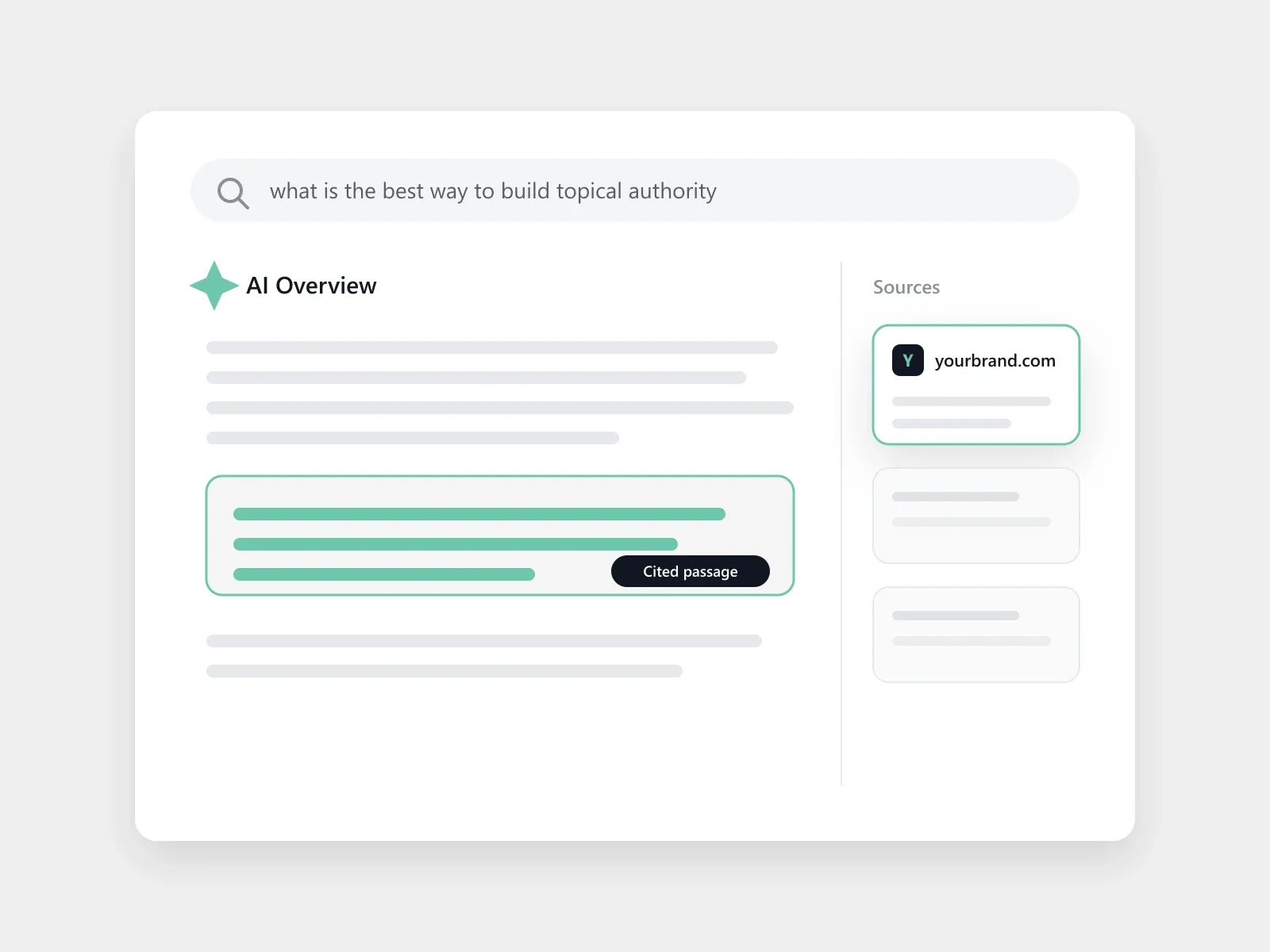
AI Overviews, ChatGPT and Perplexity cite sources that state facts clearly, resolve entities confidently and stay consistent.
Generative engine optimization (GEO) is semantic SEO under stricter conditions. Passages must make sense on their own, entities must be unambiguous and facts must not contradict each other across your site. AI citations still depend on ranking well in classic search, so we build both together.
- Self-contained, citable passages
- Entity disambiguation and brand consistency
- Structured data for key facts
- Tracking of AI Overview and LLM mentions
Tools we use for semantic SEO
Tools give us data. Decisions about entities, page jobs and links are made by people.
12 tools
Measurement · Entities · Research · Technical · Structured data · NLP
Measurement
- Google Search ConsoleQuery-level impressions, unique queries per page, cluster visibility and cannibalization.
Entities
- Google Natural Language APIShows which entities Google’s NLP detects on a page and how salient each one is.
- Knowledge Graph Search APIChecks whether an entity exists in Google’s Knowledge Graph and how it is identified.
- InLinksEntity-based content analysis and internal linking suggestions.
Research
- AhrefsCompetitor topics, content gaps, ranking pages and backlink profiles.
- SemrushKeyword and SERP data, topic research and position tracking.
- AlsoAskedMaps People Also Ask question trees to shape query networks.
- Keyword InsightsSERP-based clustering that groups queries by shared intent.
Technical
- Screaming Frog SEO SpiderCrawls architecture, internal links, orphans, canonicals and structured data.
- PageSpeed InsightsField and lab data for Core Web Vitals: LCP, INP and CLS.
Structured data
- Schema Markup ValidatorValidates schema, alongside Google’s Rich Results Test.
NLP
- Python and spaCyCustom entity extraction, query clustering and embedding analysis at scale.
How we deliver semantic SEO
Eight steps in a fixed order, each with a clear deliverable. Running them out of order produces maps that look right but do not fit the business.
- 01
Audit and source context
Your business, audience and competitors, plus a technical and content audit.
Semantic SEO audit report
- 02
Entity model
Central entity, attributes, values and the relationships between them.
Entity and attribute sheet
- 03
Query network
Real searches collected, grouped by need and branched by intent.
Query network by intent
- 04
Topical map
One job per page, core and outer sections, and the publishing order.
Topical map and roadmap
- 05
Briefs and content
Semantic briefs, then new pages and optimization of existing ones.
Briefs and published pages
- 06
Links and technical
Internal link network, schema and a lower cost of retrieval.
Link plan and technical fixes
- 07
Authority
Off-page SEO, digital PR and guest posts aligned with the map.
Placement and mention report
- 08
Measure and expand
Coverage and cluster reporting, then the next layer of the map.
Monthly coverage report
How we measure semantic SEO
Semantic SEO moves whole topic clusters before it moves single keywords, so tracking a handful of terms misses most of the progress.
The usual sequence: unique ranking queries per page rise first, impressions follow, average position improves across the cluster, and core-page conversions come last. We report on all of it, so you can see momentum long before the revenue arrives.
What semantic SEO is not
Most “semantic SEO” we audit is keyword SEO with new vocabulary. These are the patterns we remove.
Common mistakes
- Starting from a keyword export instead of source context
- Several intents competing on one page
- Naming attributes without giving values
- Publishing the hardest core pages first
- Mixing education and selling on the same page
Shortcuts we avoid
- Stuffing synonyms or “LSI keywords”
- Chasing third-party NLP scores
- Hundreds of AI pages without an entity model
- Schema that describes content not on the page
- Related-post links with no stated reason
Frequently asked questions about Semantic SEO
What is semantic SEO?
Semantic SEO is the practice of optimizing a website around entities, topics and search intent rather than single keywords, so search engines understand what each page means and how it fits into a wider subject.
What is an example of semantic SEO?
A service page that defines the service, covers related problems, attributes and pricing factors, answers real questions, links to related pages and uses structured data, instead of repeating one keyword throughout the copy.
How is semantic SEO different from traditional SEO?
Traditional SEO targets one keyword per page. Semantic SEO maps entities and intents, covers them completely, connects related pages with contextual links and adds structured data, so a site ranks across a whole subject.
What is topical authority?
Topical authority is the state where search engines reliably predict your site is relevant for a subject. It grows with topical coverage and historical data, and shrinks as the cost of retrieval rises.
What is a topical map?
A topical map is a plan of every page your site needs on a subject: what each page owns, which intent it serves, how pages link, and the order to publish them in.
What are source context and central entity?
Source context is why your website exists: what you offer, to whom and why you are qualified. The central entity is the one thing your whole site is organized around. Together they decide what you should cover.
What is cost of retrieval?
Cost of retrieval is the work a search engine must do to crawl, render, understand and trust your content. Slow pages, duplicates, unclear structure and contradictions raise it; technical SEO and clear writing lower it.
What tools are used for semantic SEO?
We use Google Search Console, Google’s Natural Language and Knowledge Graph APIs, Ahrefs, Semrush, AlsoAsked, Keyword Insights, Screaming Frog, PageSpeed Insights, schema validators, InLinks and Python with spaCy. The tools provide data; the strategy is built by people.
Are guest posts still good for SEO?
Yes, when they are editorial articles on relevant websites with real audiences. Paid links on unrelated or low-quality sites can harm rankings, so every placement we make must be worth publishing without the link.
Does semantic SEO help with AI Overviews and ChatGPT?
Yes. AI answer engines favor sources with clearly defined entities, self-contained answer-first passages and consistent facts, which are the foundations of semantic SEO.
How long does semantic SEO take to work?
Most sites see early movement within three to six months, starting with more unique queries per page and rising impressions. Results compound as more of the topical map is published.
Do you write the content as well?
Yes. Our content team writes from the briefs we create, or we can brief your in-house writers.